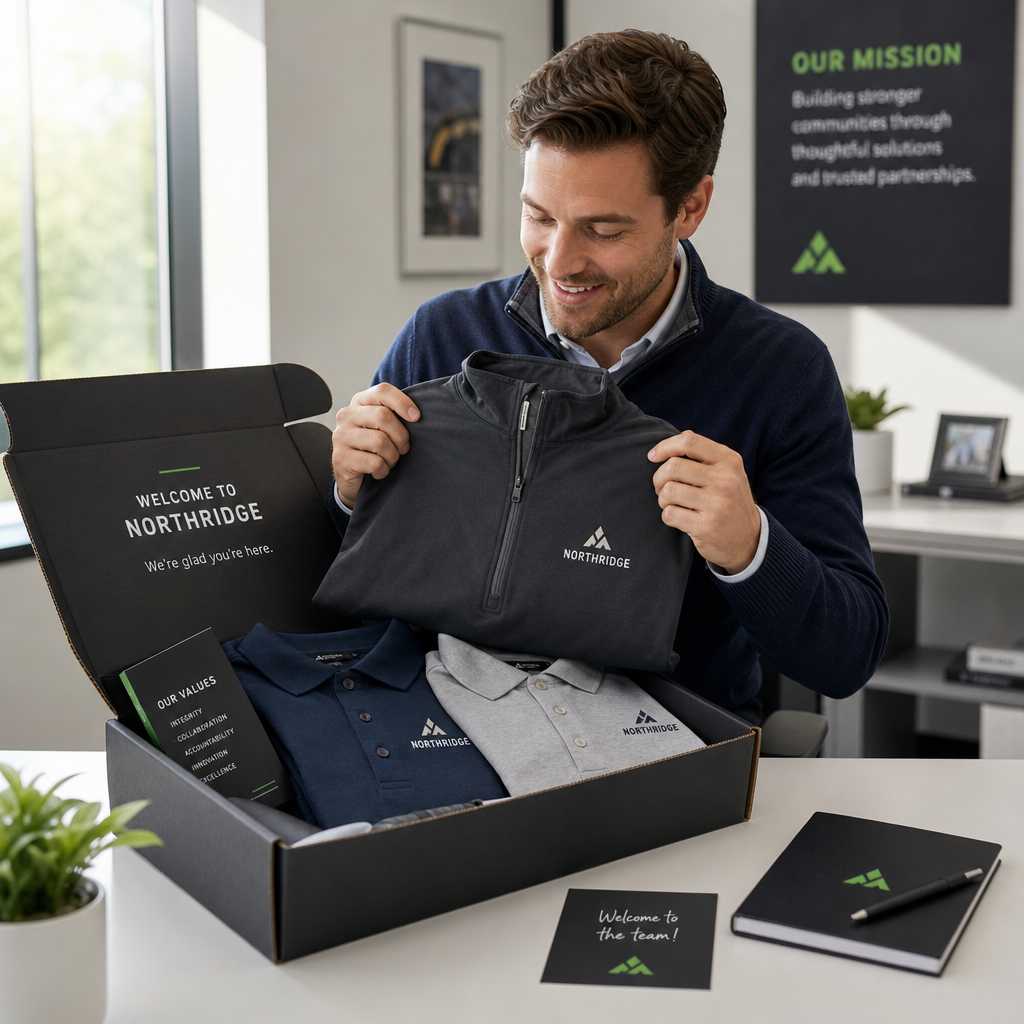
Nearly 69% of employees are more likely to stay with a company for three years if they experience great onboarding, according to SHRM research. Yet most Ohio companies hand new hires a stack of paperwork and a coffee mug and call it a welcome. A well-built corporate onboarding kit anchored by quality corporate branded apparel Ohio businesses can actually be proud of sends a different message: you belong here, and we invested in that belief before your first day ended. This article breaks down exactly how to build kits that hold up, look sharp, and make new hires feel like they joined something real.
Table of Contents
- Why Branded Apparel Belongs in Every Onboarding Kit
- Quick Takeaways
- What Goes Into a Corporate Onboarding Kit
- Choosing the Right Decoration Method
- Comparing Your Kit Apparel Options
- Sizing and Logistics: The Part Nobody Plans For
- How RDP Sports Builds Onboarding Kits for Ohio Businesses
- Frequently Asked Questions
- References
Why Branded Apparel Belongs in Every Onboarding Kit

A branded polo or quarter-zip jacket is not a perk. It is a signal. The moment a new hire puts on a piece of gear with your logo on it, they start associating themselves with your organization in a way that no orientation slide deck can replicate. This is not speculation. Research from the Advertising Specialty Institute found that branded apparel generates more impressions per dollar than nearly any other promotional product, with a single shirt averaging 3,400 impressions over its lifetime.
For Northeast Ohio businesses, this matters doubly because the region runs on relationship-based commerce. When your employee walks into a client meeting, a Chamber of Commerce event, or even a local coffee shop wearing your branded quarter-zip, your logo is working for you. That is earned visibility that starts on day one of employment.
The mistake most businesses make is treating onboarding apparel as an afterthought. They order whatever is cheapest, apply a two-color screen print, and ship it to HR the week before a hire starts. The result is a shirt that fades after six washes and a new employee who leaves it folded in a drawer. Quality matters, decoration method matters, and fit matters. All three are fixable problems if you plan them in advance.
Quick Takeaways
| Key Insight | Explanation |
|---|---|
| Embroidery outlasts screen printing on polos and jackets | For corporate staples like button-downs and outerwear, embroidery holds color and structure through repeated washing far better than a standard plastisol screen print. |
| DTF transfers work best for complex, full-color logos | If your brand mark has gradients or more than four colors, direct-to-film transfer printing preserves detail without the setup cost of multi-screen printing. |
| Include at least one wearable and one functional item | A kit with only a t-shirt gets used occasionally. Add a branded notebook, tumbler, or bag and daily visibility increases across multiple touchpoints. |
| Pre-size kits using a simple pre-hire intake form | Sending a one-question size preference email during the offer stage eliminates the awkward exchange of wrong-size shirts on day one. |
| Rush production is available but should not be the default | Planning kits 3 to 4 weeks out gives your decorator time to produce quality work. Rush orders cost more and carry higher error risk. |
| Branded outerwear has the highest perceived value | Employees consistently rate branded jackets and hoodies as the most appreciated onboarding gift because they are items the employee would actually buy themselves. |
| Consistent logo placement builds brand recognition over time | Left chest for embroidery, center chest for screen printing. Pick one standard and apply it across all items in every kit you produce. |
What Goes Into a Corporate Onboarding Kit
A strong onboarding kit has a hierarchy. The anchor piece is always a wearable, and it should be the item with the highest perceived value in the box. For most Ohio businesses, that means a custom embroidery polo or a branded performance quarter-zip. These are items employees will wear to client sites, company events, and in daily work environments without being asked.
Supporting items fill out the kit. A well-chosen branded tumbler or water bottle adds daily desk presence. A custom notebook or padfolio gives the new hire a branded tool they will use in meetings from their first week. A branded tote or backpack doubles as the packaging for the kit and becomes its own visible asset once the hire is on the job.
What to Avoid Putting in the Kit
Skip the branded stress balls, cheap pens, and novelty items. They communicate the opposite of what you intend. A low-quality item with your logo on it trains the recipient to associate your brand with low quality. If budget is tight, do fewer items at higher quality rather than more items at bargain rates.
Also avoid over-branding. One logo placement per item is professional. Logos on the chest, sleeve, and back of the same shirt looks like a racing sponsor layout, not a corporate brand. Pick the placement that matches the decoration method and leave the rest of the garment clean.
Kit Tiers Worth Considering
Not every hire needs the same kit. In practice, a tiered structure works well for companies that onboard at different levels. An entry-level kit might include a branded t-shirt and tumbler. A manager-level kit adds an embroidered polo and padfolio. A director or executive kit steps up to a custom jacket and premium bag. Tiering keeps costs manageable while signaling that the company recognizes different roles appropriately.
Choosing the Right Decoration Method
This is where most businesses get it wrong because they default to whatever the promotional vendor offers without understanding the trade-offs. There are three primary methods relevant to corporate onboarding apparel: screen printing, embroidery, and DTF (direct-to-film) transfers. Each has specific strengths and the wrong choice makes a quality garment look cheap.
Screen Printing
Screen printing is ideal for t-shirts, hoodies, and casual wear where a flat, bold logo reads well. It is cost-effective at higher quantities and works across a wide range of fabric types. The limitation is durability on items that get frequent washing, and it does not work well on structured fabric like the chest of a polo or the surface of a jacket.
Custom Embroidery for Businesses
Custom embroidery for businesses is the correct choice for polos, button-downs, outerwear, and hats. The thread-based application is permanent, does not crack or peel, and conveys a level of professionalism that screen printing cannot match on structured garments. For corporate kits specifically, embroidery on the left chest of a polo is the industry standard for a reason: it looks intentional and polished at every meeting a new hire attends.
The practical limitation of embroidery is that it does not handle extremely complex or gradient-heavy logos well. If your logo has fine detail or photographic elements, embroidery will require a simplified version. A good decorator will help you digitize a clean version of your mark before production begins.
DTF Transfers
DTF is the right call for full-color, detail-heavy applications or small-batch runs where screen printing setup costs are not justified. For onboarding kits that include branded bags or accessories where embroidery is not practical, DTF delivers sharp results with no minimum quantity restrictions. It is also excellent for inside-label or tag printing if you want to brand the garment on the interior as well.
“The decoration method you choose communicates as much about your brand as the logo itself. A poorly embroidered crest on a cheap polo tells your new hire exactly how much thought went into their welcome.” – Sourced from Advertising Specialty Institute industry reporting on branded merchandise quality standards.
Comparing Your Kit Apparel Options
Choosing the right garment type for the anchor piece in your kit depends on your company culture, client-facing expectations, and budget. The table below compares the three most common corporate kit anchor items based on factors that actually matter for an onboarding context.
| Apparel Item | Best Decoration Method | Best Fit For |
|---|---|---|
| Performance Polo | Left-chest embroidery | Client-facing roles, sales teams, field employees, corporate environments with a business-casual dress code |
| Quarter-Zip Pullover | Left-chest embroidery or DTF chest logo | Tech companies, creative agencies, corporate teams that value versatility across office and outdoor settings |
| Heavyweight Cotton or Tri-Blend T-Shirt | Center-chest or full-back screen print | Casual work cultures, internal teams, organizations with a strong community or spirit identity |
Pro tip: If you are unsure which anchor piece fits your culture, ask your last three hires what branded apparel they actually wear from previous jobs. Their answers will tell you more than any style guide.
Sizing and Logistics: The Part Nobody Plans For
The single most common operational failure in corporate onboarding kits is the sizing problem. HR orders kits in bulk with a distribution across sizes that does not match the actual incoming hires. The result is a closet full of XL polos and no mediums, or vice versa. This is entirely preventable.
The solution is a pre-hire size intake. When a new hire accepts their offer, include a one-question form alongside their onboarding paperwork asking for their preferred size in the specific garment type. This data feeds directly into the production order. Most businesses resist this step because it feels like extra admin, but it eliminates the cost of wrong-size returns, re-orders, and the impression a mis-sized shirt makes on day one.
Managing Inventory for High-Volume Hiring
Companies that onboard 10 or more employees per quarter should consider maintaining a standing inventory with their decorator rather than placing one-off orders. In practice, this means pre-ordering a set quantity of decorated garments across a size distribution, storing them, and pulling from stock as each hire arrives. The decorator holds the inventory or the company keeps a small supply on-site. Either approach reduces per-unit cost and eliminates production lead time for each individual hire.
RDP Sports works with several Northeast Ohio companies on exactly this model, producing decorated inventory runs quarterly so HR always has kits ready to go. The alternative, placing a single-unit rush order every time someone starts, costs significantly more per piece and puts production quality at risk.
Pro tip: Order 10 to 15 percent above your projected quarterly hiring volume to account for sizing exchanges and unexpected fast hires. Branded polos do not expire and the buffer prevents the scramble that happens when two people start on the same Monday.
How RDP Sports Builds Onboarding Kits for Ohio Businesses
RDP Sports has been producing custom apparel for Northeast Ohio businesses for over 25 years. With 500,000 or more orders fulfilled and in-house screen printing, embroidery, and DTF capabilities, the company is structured specifically for the kind of repeatable, brand-consistent production that corporate onboarding kits require. This is not a fulfillment warehouse that handles branded merchandise on the side. It is a production facility where the decoration happens under the same roof as the design work.
For corporate clients, RDP Sports assigns a dedicated account manager who carries institutional knowledge of your brand standards across every order. That means your logo is digitized correctly for embroidery once, and that digitization file is stored and reused on every subsequent order without re-approval delays. The left chest placement on your polo looks identical on the kit you order in March and the kit you order in October.
What the Process Looks Like in Practice
A new corporate client typically starts with a consultation, either in person at the Mentor, Ohio showroom or through a dedicated account manager. Logo files are reviewed, garment options are narrowed down based on culture and budget, and a sample or digital mockup is approved before production begins. For recurring clients, this process compresses significantly because the foundational decisions have already been made.
Rush production options are available for businesses that need kits turned around quickly, but the standard recommendation is a 3 to 4 week lead time for decorated apparel. That window allows for proper digitization, quality checking, and any minor corrections before garments go to the new hire. Competitors who promise 48-hour turnarounds on embroidered corporate wear are either running pre-made inventory or cutting corners on quality checks. Neither outcome serves a corporate brand well.
Businesses interested in building a repeatable onboarding kit program can visit RDP Sports or stop into the showroom to see decoration samples in person before committing to a production run.
Frequently Asked Questions
What is the minimum order quantity for corporate onboarding kits?
Minimum order quantities vary by decoration method. Screen printing typically requires a minimum of 12 to 24 pieces per design to offset setup costs. Embroidery minimums are lower, sometimes as few as 6 pieces, because setup costs are captured in the digitization fee rather than per-piece setup. DTF transfers have the lowest minimums and can be ordered in single-unit quantities, making them practical for small-batch or one-off kit items. If your company onboards fewer than 10 people per year, DTF and embroidery are your most cost-effective options.
How long does it take to produce a corporate branded apparel order?
Standard production runs for decorated corporate apparel take 2 to 4 weeks from approved artwork to completed goods. That window includes garment procurement, digitization or screen setup, production, and quality review. Rush options can compress the timeline to 5 to 10 business days but carry additional cost and should be reserved for urgent situations rather than used as the standard planning window. Building a 4-week buffer into your hiring timeline eliminates the need for rush orders in most cases.
Is embroidery or screen printing better for corporate polo shirts?
Embroidery is the correct choice for corporate polos without exception. The structured weave of a polo does not accept screen printing well, and the resulting application tends to feel stiff and crack over time. Embroidery thread integrates into the fabric, holds its color permanently, and communicates a level of professionalism consistent with what a polo is meant to signal. The only scenario where screen printing makes sense on a polo is a large back print, which is rarely appropriate for corporate wear.
Can we include multiple logo versions or departments in the same kit run?
Yes, but it adds complexity and cost. If you have a company-wide logo and department-specific sub-marks, each variation requires its own digitization or screen setup. The practical approach is to use the company-wide mark for the primary anchor piece and reserve any department-specific branding for secondary items like notebooks or bags where setup costs are lower. Discuss the logo variation plan with your account manager before ordering so the production schedule and pricing reflect the actual scope.
What budget should a company plan for a single corporate onboarding kit?
A quality onboarding kit with one embroidered anchor piece, one functional branded item, and a simple branded bag or packaging typically runs between $75 and $150 per kit depending on garment selection, decoration complexity, and order volume. Executive-tier kits with premium outerwear and multiple items can run $150 to $300. Below $50 per kit, quality trade-offs become visible and the kit stops serving its purpose. The cost is modest relative to what a company typically spends recruiting and onboarding a single employee, which SHRM estimates averages $4,100 per hire.
We would love to hear how your company currently handles onboarding kits and what has worked or not worked for your team.
References
- SHRM research on employee onboarding outcomes and retention statistics
- Forbes coverage of corporate culture, employee experience, and branded workplace programs
- HubSpot marketing statistics on brand recognition and promotional merchandise effectiveness
- Statista data on the promotional products industry and branded apparel market size
- McKinsey research on employee engagement and organizational onboarding best practices