Most small organizations in Northeast Ohio have been burned by the same problem: a minimum order requirement of 24 pieces when you only need 12, or a screen printing quote that makes a simple spirit wear run feel like a capital investment. DTF printing Ohio is the technology that removes those friction points entirely. Direct to film transfers let RDP Sports produce full-color, photo-quality graphics on virtually any fabric, in quantities as low as one piece, without the setup costs that made small-batch custom apparel economically painful for decades. If someone referred you here, they almost certainly dealt with this problem themselves.
Table of Contents
- Quick Takeaways
- What Is DTF Printing, Exactly?
- How DTF Differs from Screen Printing and Embroidery
- Why DTF Is Built for Small Organizations
- What DTF Printing Works Best On
- DTF vs. Other Methods: A Direct Comparison
- Common Mistakes Organizations Make with DTF
- How RDP Sports Uses DTF for Northeast Ohio Clients
- Frequently Asked Questions
- References
Quick Takeaways
| Key Insight | Explanation |
|---|---|
| No minimum order quantities | DTF transfers can be produced for a single piece, making them practical for booster clubs, small travel leagues, and one-off recognition items. |
| Full-color without setup fees | Unlike screen printing, DTF requires no screens or color separations, so a 6-color design costs the same to set up as a 1-color design. |
| Works on dark and light fabrics | DTF transfers include a white ink base layer, which means vibrant colors land correctly on black, navy, or any dark garment without extra cost. |
| Faster turnaround than screen printing | Because there is no screen-burning or color registration process, direct to film transfers move from artwork approval to finished garment faster. |
| Ideal for mixed garment types in one order | One DTF film can be heat-applied to a cotton tee, a polyester jersey, and a nylon jacket in the same run, something screen printing cannot do efficiently. |
| Soft hand feel with high durability | Modern DTF inks stretch and flex with the fabric. The transfer does not crack under normal washing conditions when applied correctly. |
| Cost-effective for custom apparel small orders | For orders under 24 pieces, DTF is almost always the lowest cost-per-unit option among full-color decoration methods. |
What Is DTF Printing, Exactly?

DTF stands for direct to film. The process works by printing a design onto a special PET film using water-based inks, then applying a hot-melt adhesive powder to the wet ink before curing everything in a conveyor oven. The result is a flexible transfer that can be heat-pressed onto almost any fabric at around 320 degrees Fahrenheit for 15 to 20 seconds.
What makes the process different from older transfer methods is the ink system. DTF printers use CMYK inks plus a white ink channel, which allows the printer to lay down an opaque white base automatically. This eliminates the color-bleed problem that plagued older iron-on transfers on dark garments and removes the need for an operator to manually plan a white underbase the way screen printers do.
In practice, the film used in DTF printing has nothing to do with the garment at the time of printing. The transfer is produced as a standalone product and can be stored for weeks before application. This means a shop can batch-print transfers during slow periods and apply them on demand, a workflow that benefits anyone placing custom apparel small orders on a short timeline.
How DTF Differs from Screen Printing and Embroidery
Screen printing has been the standard for volume apparel for 60 years, and for good reason. When you are printing 144 identical t-shirts in two colors, the cost per unit is hard to beat. But screen printing requires a physical screen for every color in your design. A six-color logo means six screens, six setup charges, and a press operator who has to register each color layer precisely. That economics model breaks down entirely below 24 pieces.
Where embroidery fits and where it does not
Embroidery produces a premium, tactile result that DTF does not replicate. For polo shirts, quarter-zips, and corporate hats, embroidery is still the right answer. The limitation is complexity. Intricate photographic artwork, gradient fills, and extremely fine text do not translate well to thread. Embroidery also adds weight and stiffness to the decoration area, which matters on athletic garments where fabric performance is part of the product.
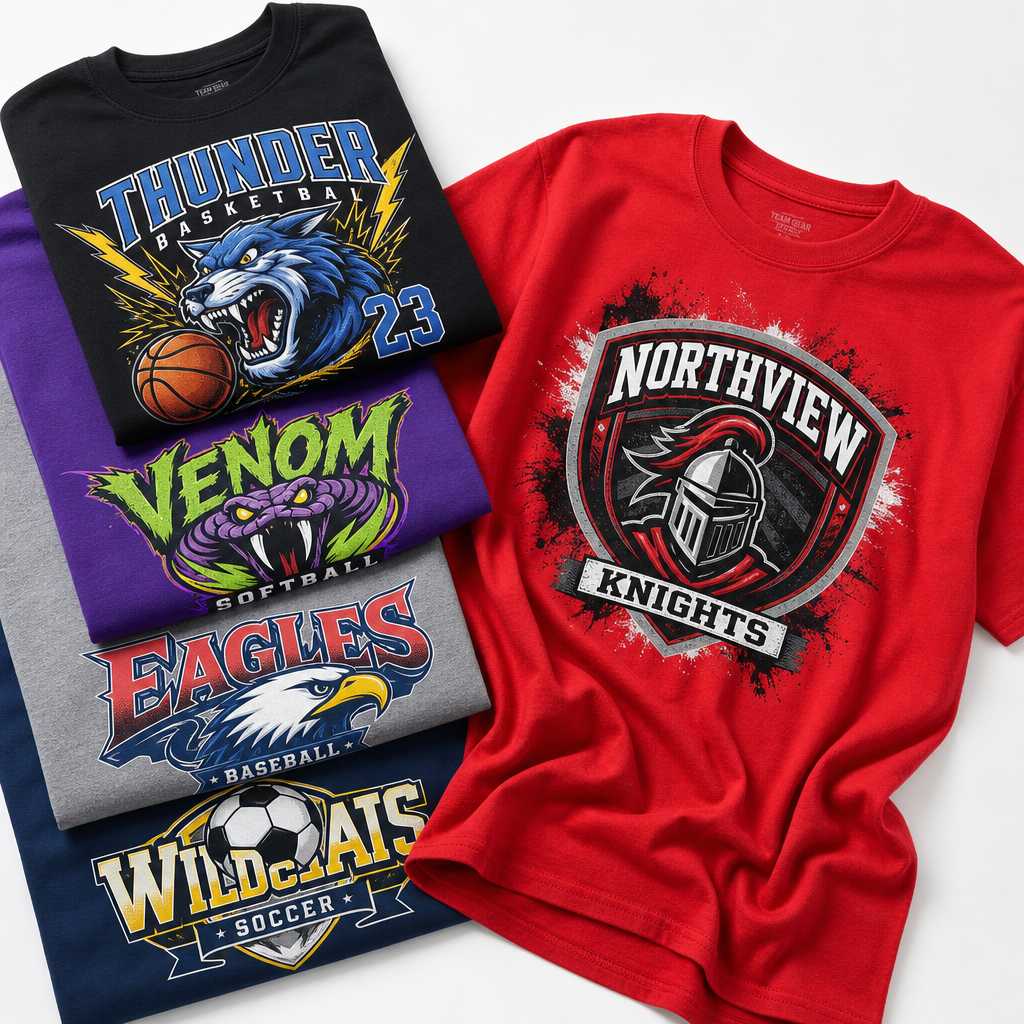
DTF transfers sit between screen printing and embroidery in terms of feel. They are flatter than embroidery and slightly more tactile than a traditional plastisol screen print. For spirit wear, travel league uniforms, corporate event shirts, and booster club gear, the result looks professional and holds up to regular laundering.
“The custom decorated apparel market in the United States continues to grow, driven in large part by demand for shorter runs and faster turnaround. Digital decoration technologies like DTF are capturing market share that was previously inaccessible to small-volume buyers.” – Decorated Apparel Industry Research, Statista Market Outlook
Why DTF Is Built for Small Organizations
The economics of DTF printing are genuinely different from legacy decoration methods, and the difference favors small buyers. A booster club ordering 10 custom hoodies for senior night does not need to subsidize the setup cost of a 100-piece screen printing run. With DTF, the cost structure is almost entirely variable, meaning you pay for what you print, not for the infrastructure required to print it.
For a travel baseball league with eight teams, each needing a slightly different design, DTF is the only practical full-color option. Creating eight different screen printing setups would be cost-prohibitive. DTF handles each design as a digital file with no additional setup charge between them.
Rush production becomes realistic
Because DTF eliminates the screen-making step, rush orders move faster through production. At RDP Sports, this matters for clients who need spirit wear for a Friday game announced on a Monday, or a corporate team that forgot to order branded shirts before a trade show. The data consistently shows that organizations with access to fast, small-batch decoration order more frequently and build stronger brand consistency over time than those who batch up large orders once a year to justify setup costs.
Pro tip: If your organization has multiple sports seasons or recurring events throughout the year, ask RDP Sports about storing your approved DTF artwork on file. You can reorder individual pieces or small batches on demand without resubmitting or re-approving artwork each time.
What DTF Printing Works Best On
DTF transfers adhere well to cotton, polyester, cotton-poly blends, nylon, and canvas. This covers the vast majority of garments used in school spirit wear, athletic uniforms, and corporate casual apparel. The only materials that consistently cause adhesion problems are silicone-coated fabrics and garments with extreme stretch, like compression shorts made of spandex-dominant blends.
In practice, the best results come from 100% cotton and 60/40 cotton-poly blends. Polyester performs well but requires slightly adjusted press temperatures to avoid scorching. Nylon jackets and bags work reliably with DTF when a Teflon sheet is used during pressing to protect the fabric surface.
Garment color has no impact on DTF print quality
This is one of the clearest advantages DTF holds over sublimation. Sublimation requires a white or very light polyester base to produce accurate colors. DTF’s white ink underbase means a red design on a black shirt looks exactly the same as a red design on a white shirt. Schools with dark team colors, which is common across Northeast Ohio where navy, black, and forest green are popular, get full-color results without any compromise.

DTF vs. Other Methods: A Direct Comparison
Choosing the right decoration method depends on your order size, design complexity, fabric type, and timeline. Here is a direct comparison of the three methods RDP Sports uses most frequently for school and business clients in Northeast Ohio.
| Factor | DTF (Direct to Film) | Screen Printing | Embroidery |
|---|---|---|---|
| Minimum order quantity | 1 piece | Typically 12-24 pieces | 1 piece (with digitizing fee) |
| Setup cost | None | Per-screen fee per color | One-time digitizing fee per design |
| Full-color complexity | Unlimited colors, no extra cost | Cost increases per color added | Limited by thread count and detail |
| Best fabric types | Cotton, poly, nylon, blends | Cotton and cotton-poly blends | Structured fabrics: polos, caps, fleece |
| Ideal for dark garments | Yes, white base included | Yes, with underbase screen added | Yes, no issue |
| Rush turnaround | Fast, no screen prep | Slower due to screen creation | Moderate, depends on stitch count |
| Cost advantage threshold | Best under 48 pieces | Best over 48 pieces per design | Best for premium items at any quantity |
Common Mistakes Organizations Make with DTF
A common mistake is assuming DTF is automatically cheaper than screen printing at every quantity. It is not. At 72 identical t-shirts in two colors, screen printing wins on price. DTF is the cost leader for low quantities and high design complexity. Matching the method to the actual order profile is what produces the best value, and this is where working with an experienced account manager matters more than shopping for the lowest base price online.
Another mistake is submitting low-resolution artwork. DTF prints at high resolution, typically 300 DPI or higher, which means it will faithfully reproduce whatever you send, including pixelation and blurry edges in a 72 DPI PNG exported from a website. Screen printing sometimes masks low-resolution files because the halftone dot pattern softens the edges. DTF does not. Send vector files or high-resolution rasterized artwork at print size.
Pro tip: When placing a DTF order at RDP Sports, ask your account manager to send a digital proof at 100% scale before production begins. What looks clean on a phone screen at thumbnail size can reveal edge quality issues when viewed at actual print dimensions.
How RDP Sports Uses DTF for Northeast Ohio Clients
RDP Sports integrated DTF production into its in-house capabilities to serve exactly the clients that national providers like BSN Sports and Adler Team Sports handle poorly: the booster club ordering 8 hoodies, the city recreation department needing 15 staff shirts in three different sizes, the small business sponsoring a local 5K who wants 20 custom tees without paying for 72.
With 25 years of production experience and more than 500,000 orders fulfilled, the team at RDP Sports uses DTF not as a replacement for screen printing or embroidery but as a tool that fills the gap those methods leave. A school might use screen printing for a 200-piece homecoming t-shirt run, embroidery for coaching staff polos, and DTF for the 10 senior recognition hoodies that need individual names printed on the back.
The account manager advantage
National competitors route small orders through online configurators and automated quoting systems. RDP Sports assigns a dedicated account manager to each client. For DTF specifically, this matters because the right method choice, artwork prep, fabric selection, and quantity threshold all interact. A human who knows your school’s colors, your annual event calendar, and your budget history makes faster and more accurate recommendations than a dropdown menu.
The neighborhood showroom in Northeast Ohio also lets clients touch sample garments with DTF prints before committing to an order. Seeing and feeling a DTF transfer on the actual fabric you plan to order removes uncertainty that online-only providers cannot address.
Frequently Asked Questions
How long do DTF transfers last on garments?
When applied correctly and cared for properly, DTF transfers typically last 50 or more wash cycles without significant cracking or peeling. Washing garments inside out in cold water and avoiding high-heat dryer cycles extends the lifespan considerably. The durability is comparable to a standard plastisol screen print under normal use conditions.
Can DTF printing handle photographic images on shirts?
Yes, and this is one of the areas where DTF outperforms every other decoration method available to small organizations. Because DTF prints continuous-tone color using CMYK inks, it can reproduce photographs, gradient artwork, and complex multi-color logos without simplifying the design. Screen printing requires converting photos to halftone dot patterns, which reduces image quality at small print sizes.
What is the minimum order for DTF printing at RDP Sports?
RDP Sports does not impose a standard minimum quantity requirement for DTF orders the way screen printing setups demand. Single-piece orders are possible. Pricing scales with quantity, so larger orders cost less per unit, but the absence of screen fees means even a single custom piece is priced fairly relative to the actual production cost.
Is DTF printing the same as heat transfer vinyl (HTV)?
No. Heat transfer vinyl involves cutting a design from a sheet of colored vinyl and pressing it onto a garment. It works well for simple one or two-color designs but cannot reproduce photographic images or fine detail. DTF is a printed process that uses ink deposited onto film, producing the same kind of detail resolution as a digital photograph. The two methods look noticeably different side by side, with DTF producing far more complex and vibrant results.
Does DTF work on athletic performance fabrics?
DTF works on most athletic polyester fabrics, including moisture-wicking jerseys. The main variable is the press temperature. High-performance polyester can scorch at temperatures used for cotton, so the heat press settings need to be adjusted. RDP Sports’ production team manages these settings based on the specific garment fabric, which is one reason ordering through an experienced local provider produces better results than using a mail-in DTF transfer service where you apply the transfer yourself.
How does DTF printing in Ohio compare to ordering from a national online provider?
The primary differences are turnaround time, accountability, and the ability to handle revisions. National online providers optimize for high-volume standardized orders. If your artwork needs adjustment, you are dealing with a support ticket and a timezone gap. RDP Sports handles DTF printing Ohio in-house, which means artwork revisions happen the same day, rush orders are genuinely possible, and your account manager knows the status of your order without you having to track a portal.
We would love to hear how your organization has handled custom apparel for small runs in the past and whether DTF is something your team has considered or already tried.
References
- Statista market data on the U.S. custom apparel and decorated products industry, including growth trends in digital decoration methods
- Forbes coverage of small business manufacturing and on-demand production trends affecting local apparel providers
- U.S. Environmental Protection Agency guidelines on water-based ink systems and environmental compliance in garment decoration
- Ahrefs research on local search behavior and how small organizations find custom apparel vendors in regional markets
- HubSpot statistics on referral-based purchasing decisions and their influence on local service provider selection