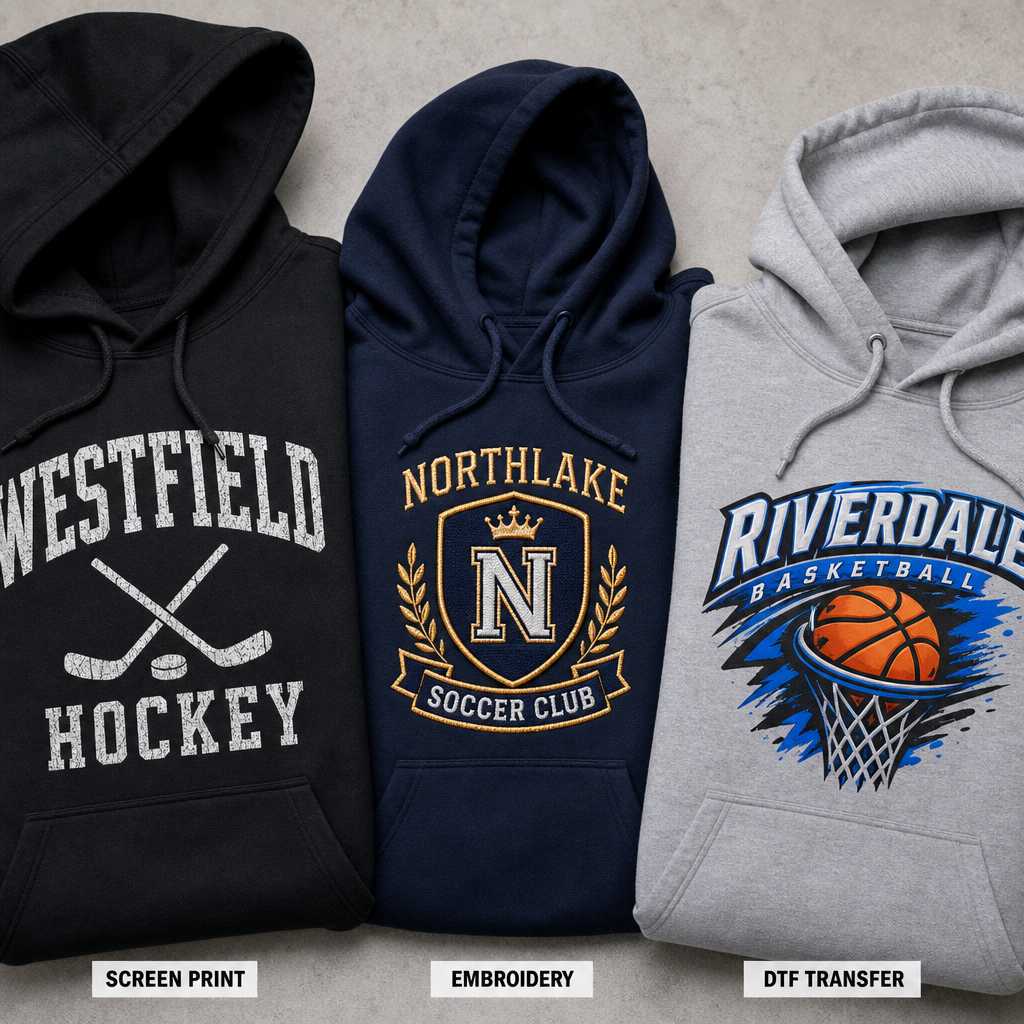
Most teams waste money on the wrong decoration method because nobody told them the tradeoffs upfront. Ordering 48 screen printed hoodies sounds straightforward until you realize the ink cracks after a season, or you paid a steep setup fee for a one-time event run of 12 shirts. The question of screen printing vs embroidery is not just about aesthetics. It is about durability, cost per unit, turnaround time, and what your garment can actually handle. Add DTF transfers to the mix and the decision gets more layered. This guide gives you a straight answer based on real production experience, not a manufacturer brochure.
Table of Contents
- Quick Takeaways
- What Is Screen Printing and When Should You Use It
- What Is Embroidery and When Should You Use It
- What Are DTF Transfers and Why Ohio Teams Are Adopting Them
- Side-by-Side Comparison: Screen Printing, Embroidery, and DTF
- Choosing by Use Case: Spirit Wear, Uniforms, Corporate Gear
- Common Mistakes Teams Make When Ordering Custom Apparel
- Frequently Asked Questions
- References
Quick Takeaways
| Key Insight | Explanation |
|---|---|
| Screen printing is cheapest at volume | Setup costs are fixed, so the per-unit price drops sharply once you clear 24 to 48 pieces. Below that, you are paying for screens you barely use. |
| Embroidery outlasts all other methods on structured garments | Stitched logos on polos, caps, and jackets survive hundreds of washes without fading or peeling. That durability is why athletic departments order it for staff apparel. |
| DTF transfers solve the small-run problem | No screens, no minimum order requirements, and full-color photographic detail at quantities as low as one piece. DTF transfers Ohio demand has grown fast for exactly this reason. |
| Not every garment handles every method | Embroidery adds weight and stiffness to thin performance fabrics, which can irritate athletes. Screen printing on dark polyester can cause dye migration if the printer skips heat-resistant inks. |
| The best custom apparel decoration method depends on garment type first | Start with the fabric, then the quantity, then the complexity of the artwork. Reversing that order is the most common ordering mistake. |
| Rush production is possible with all three methods, but DTF is fastest | DTF transfers can be printed and applied same day in many cases. Screen printing requires screen setup time. Embroidery is the most time-intensive at scale. |
| Mixing methods on a single order is often the right answer | A school might screen print 200 student spirit shirts, embroider staff polos, and use DTF for a dozen senior recognition shirts with individual names and photos. |
What Is Screen Printing and When Should You Use It

Screen printing forces ink through a mesh stencil directly onto fabric. Each color in your design requires a separate screen, which is why setup costs exist and why simple designs with fewer colors cost less to produce. The ink is then heat cured, bonding it to the garment fibers.
In practice, screen printing is the most cost-effective option for large, uniform orders. A booster club ordering 150 identical spirit tees in two colors will pay significantly less per unit with screen printing than with any other method. The breakeven point where screen printing beats DTF on price is typically around 24 pieces for simple designs.
The limitations matter too. Screen printing produces vibrant, opaque results on cotton and cotton blends, but 100% polyester uniforms require specialty inks and experienced operators to avoid dye migration, a problem where the polyester dye bleeds into the printed ink over time and turns a white logo pink or gray. RDP Sports handles this in-house, but it is a real issue when ordering from shops that cut corners on materials.
Where Screen Printing Wins for Ohio Schools and Organizations
High-volume spirit wear, event shirts, fundraiser tees, and summer camp apparel are the strongest use cases. If everyone on the order gets the same design, screen printing is almost always the right call above 48 pieces.
Screen printing also produces a softer hand feel than embroidery on wearable items like t-shirts and hoodies. A student wearing a spirit hoodie for eight hours on a game day notices the difference.
Pro tip: If your school’s booster club orders spirit wear every year, lock in your screens with a supplier that stores them between seasons. RDP Sports offers account management that tracks your past orders, which means you are not recreating your design or setup from scratch each fall.
What Is Embroidery and When Should You Use It
Embroidery stitches thread directly into the fabric using a digitized file that tells the machine exactly where each needle pass goes. The result is a raised, textured logo that does not fade, crack, or peel. It looks expensive because it is more labor intensive to produce.
The durability of embroidery is measurable. Properly stitched logos on polo shirts or caps can survive 200 or more commercial wash cycles without visible degradation. For school staff, corporate teams, or travel league coaches who wear their gear multiple times per week, that longevity justifies the higher per-unit cost.
Where Embroidery Excels and Where It Fails
Embroidery is the correct method for structured garments: polo shirts, fleece jackets, letterman jackets, staff uniforms, caps, and bags. These are items with enough body to support the added weight of stitching without distorting the fabric.
A common mistake is ordering embroidery on thin, stretchy performance shirts or on large chest logos with heavy fill stitching. The added thread weight puckers lightweight fabric and restricts movement on athletic cuts. The rule is straightforward: if the garment is for active athletic use, embroidery belongs on outerwear and headwear, not on the game-day jersey itself.
Embroidery also has a color limitation that matters for complex logos. Gradients, photographic images, and designs with more than 12 to 15 colors either cannot be reproduced or require compromises that dilute the original design. If your logo has a gradient or realistic photography, embroidery is not your method.
Pro tip: Before approving an embroidery order, ask your decorator to run a stitch-out sample on the actual garment fabric you are ordering. A design that looks clean on paper can pucker or lose detail once it is stitched on a specific weave. RDP Sports does this in-house before running full production on large orders.
What Are DTF Transfers and Why Ohio Teams Are Adopting Them
DTF, which stands for Direct-to-Film, prints a full-color design onto a special film, coats it with hot-melt adhesive powder, and heat-presses it onto the garment. The process does not require screens, plates, or minimums. DTF transfers Ohio providers have expanded quickly because the method fills a real gap that screen printing and embroidery cannot.
The critical advantage is flexibility. A travel soccer league with 22 players can order jerseys with individual player names and numbers at a reasonable per-unit cost because there are no setup costs for each unique variation. A business ordering a single custom shirt for a new employee does not pay a setup penalty.
“The custom apparel industry has shifted meaningfully toward on-demand, small-batch production. Buyers expect full-color customization at low quantities, and decoration technology has finally caught up to that demand.” – SGIA (Specialty Graphic Imaging Association) Industry Report
DTF Performance on Different Fabrics
DTF transfers adhere well to cotton, polyester, blends, nylon, and even some performance fabrics where screen printing struggles. The heat press application is forgiving across garment types, which makes DTF the most versatile method for mixed-fabric orders.
Durability is a legitimate question. Early DTF technology produced transfers that cracked or peeled faster than screen printing. Current adhesive formulations, when applied correctly at the right temperature and pressure, produce washes that hold well through 50 or more laundry cycles. That is sufficient for most spirit wear and event apparel. For gear expected to last three or more seasons of heavy use, embroidery or screen printing still has an edge in raw longevity.

Why DTF Works for Northeast Ohio’s Ordering Patterns
Northeast Ohio schools and organizations often run late-season orders, senior recognition events, or mid-year additions to existing programs. DTF makes those small, time-sensitive additions possible without the cost penalty that screen printing imposes on low quantities. Teams ordering 6 to 20 pieces will almost always get better value from DTF than from screen printing or embroidery.
Side-by-Side Comparison: Screen Printing, Embroidery, and DTF
The table below is built from production realities, not marketing language. Use it to narrow your method before calling your decorator.
| Factor | Screen Printing | Embroidery | DTF Transfers |
|---|---|---|---|
| Minimum order to be cost-effective | 24 to 48 pieces | 12 to 24 pieces | 1 piece |
| Setup cost | High (per screen per color) | Medium (digitizing fee) | None |
| Color complexity | Up to 8 to 10 spot colors | Limited to thread colors, no gradients | Unlimited, full CMYK |
| Best garment types | Cotton t-shirts, hoodies, tote bags | Polos, caps, jackets, bags | Most fabric types including performance blends |
| Durability rating | High (100 or more washes) | Very high (200 or more washes) | Moderate to high (50 or more washes with correct application) |
| Rush production speed | 2 to 5 business days after approval | 3 to 7 business days at volume | Same day to 2 business days |
| Per-unit cost at 100 pieces | Lowest | Highest | Middle |
| Ideal for individual name or number variations | No, very costly per variation | Yes, with moderate cost per name | Yes, lowest cost per variation |
Choosing by Use Case: Spirit Wear, Uniforms, Corporate Gear
The best custom apparel decoration method is not a single answer. It is a function of what you are ordering, how many pieces, and how long you need them to last. Here is how that plays out across the audiences RDP Sports serves.
Spirit Wear for Schools and Booster Clubs
Spirit wear is almost always high-volume, same design, t-shirts and hoodies. Screen printing wins here cleanly. If your booster club is ordering 200 hoodies in school colors for a homecoming event, you are not going to find a more cost-effective path than screen printing with a two or three color design on a cotton blend blank.
The exception is senior recognition or specialty items where personalization matters. A senior night shirt with each player’s name and number, ordered in a run of 12 to 25 pieces, is a DTF job, not a screen printing job.
Athletic Uniforms for Travel Leagues
Travel league uniforms live at the intersection of performance fabrics, personalization, and durability. Most modern athletic blanks are 100% polyester or moisture-wicking blends that are unfriendly to standard screen printing inks. Sublimation is often the right method for fully custom uniforms, but for adding numbers and names to a pre-made uniform, DTF handles polyester well and accommodates individual variations without the cost overhead of screen printing setup.
Jackets and outerwear for travel teams should almost always be embroidered. The team logo stitched on a coach’s quarter-zip or a player’s warm-up jacket holds up through a full competitive season and looks professional at tournaments where your organization’s image matters.
Corporate Branding and Business Apparel
Businesses ordering polos, fleece vests, or branded caps for staff should default to embroidery. Corporate apparel is worn in professional environments where the texture and permanence of embroidery signal quality. A client shaking hands with a sales rep in a well-embroidered polo notices the difference from a heat-transferred logo, even if they cannot name what they are noticing.
For event shirts, trade show giveaways, or large-batch promotional items, screen printing brings the unit cost down to a level that makes sense for high-volume corporate orders. And for last-minute additions, a new hire’s onboarding kit, or a single personalized item, DTF is the practical answer.
Common Mistakes Teams Make When Ordering Custom Apparel
After more than 25 years and 500,000 or more orders fulfilled, certain mistakes appear with enough frequency to be worth naming directly.
The first is choosing the decoration method before choosing the garment. Teams pick screen printing because it sounds familiar, then discover that the performance fabric they selected is incompatible with standard plastisol inks. Start with the garment specification, then match the decoration method to it.
The second is underestimating setup costs on small runs. A school coordinator ordering 10 custom shirts through screen printing will pay a setup fee that can represent 30 to 50 percent of the total order cost. That same order in DTF has no setup fee and often costs less overall even though the per-unit transfer cost is higher than screen printing at scale.
The third is submitting low-resolution artwork. Embroidery digitizing and screen printing film separation both require clean, vector or high-resolution artwork. Submitting a logo pulled from a website at 72 DPI creates a production delay and sometimes a redesign fee. RDP Sports has in-house design capabilities to address this, but arriving with a proper file saves time on both sides.
The fourth is ignoring the wash care instructions specific to the decoration method. DTF transfers, in particular, should be washed inside-out in cold water and dried on low heat. Schools that hand off gear to students without wash instructions will see early degradation and blame the printer when the real cause is a hot-water commercial wash cycle.
Pro tip: If you are ordering for a school or organization where multiple people handle purchasing decisions year to year, ask your account manager at RDP Sports to maintain a design file and order history on your account. Institutional knowledge about your specific setup, colors, and approved artwork is lost when a booster president rotates out and a new coordinator starts from scratch.
Frequently Asked Questions
What is the minimum order quantity for screen printing?
Most screen printing shops set a practical minimum of 12 pieces, but the cost only makes economic sense starting at 24 to 48 pieces depending on how many colors your design uses. Below that threshold, you are absorbing screen setup costs across too few garments. For orders under 24 pieces, DTF transfers almost always deliver better value.
Can DTF transfers be applied to athletic performance shirts?
Yes. DTF transfers adhere to most polyester and moisture-wicking performance fabrics where traditional screen printing inks would fail or cause dye migration issues. The heat press application works well on these fabrics as long as the temperature and pressure settings are calibrated correctly for the specific blank. This is one of the primary reasons DTF adoption has grown quickly among travel league and athletic program orders.
How does embroidery hold up on caps versus polos?
Embroidery performs well on both, but the execution differs. Caps have a structured front panel that supports dense stitch counts without distortion. Polo shirts require careful digitizing to prevent puckering on the chest, especially on pique knit fabrics. The logo file needs to be digitized specifically for the garment type, not simply scaled from one to the other. A reputable shop will maintain separate digitized files for different garment applications even if the visual logo is identical.
Is screen printing or DTF better for a multi-color full-front design?
For orders above 48 pieces, screen printing with multiple spot colors produces sharper edge definition and a more vibrant, opaque result on cotton garments. For orders below 48 pieces, or for designs with photographic gradients and complex color blending, DTF is the stronger choice regardless of quantity because it handles full CMYK color without any additional cost per color added.
How do I know which method my school’s letterman jacket should use?
Letterman jackets are an embroidery application almost without exception. The chenille body letters, school patches, and sleeve stripes on a traditional letterman jacket are stitched, not printed. Embroidery on the chest or back of a letterman jacket provides the dimensional, durable quality that matches the prestige and longevity expected from a garment students keep for decades. RDP Sports specializes in letterman jacket production for Northeast Ohio schools and can guide you through the full customization process.
What artwork file format should I submit for each method?
For screen printing, vector files in AI or EPS format are preferred, with each color on a separate layer. For embroidery, vector or high-resolution PNG files work for initial consultation, but the shop will create a separate DST or EMB digitized file for production. For DTF transfers, high-resolution PNG files with a transparent background at 300 DPI or higher are ideal. Submitting a 72 DPI JPEG exported from a social media profile will cause delays and may require a design correction fee.
What decoration method has your school or organization found works best for your specific gear needs? Share your experience below.
References
- Statista: custom apparel and promotional products industry data and market size statistics
- Forbes: business branding and corporate identity insights relevant to branded merchandise decisions
- U.S. Environmental Protection Agency: guidelines on textile inks, chemical safety, and sustainable printing practices
- Ahrefs Blog: content and search behavior data related to custom apparel and team gear purchasing trends
- HubSpot Marketing Statistics: buyer behavior and brand perception data applicable to promotional and branded apparel purchasing